 The British
English PodcastWITH CHARLIE BAXTER
You know those people who start telling a story... and everyone listens?
They could be talking about something completely ordinary.
A trip to the supermarket. An awkward moment at work. Something that happened on holiday.
But somehow, they have everyone hooked.
People are laughing, leaning in, asking questions...
And you find yourself thinking, "How do they do that?"
Imagine being able to do that yourself — in English.
Storytelling in English is a practical, 10-module course that'll help you turn everyday experiences into stories people genuinely want to listen to.
With me, Charlie Baxter.
It’s not magic. It’s something you can learn.
Those little storytelling decisions can make a surprisingly big difference to how people listen.
Why does everyone listen when THEY tell a story?
You've probably seen it happen.
You're sitting with a group of friends or colleagues.
Someone starts telling a story.
And almost immediately, everyone seems interested.
They're hanging on every word.
Someone interrupts with:
Everyone laughs.
And before the storyteller has even finished, somebody's asking:
They're not necessarily using particularly impressive vocabulary.
And the story itself might not even be that extraordinary.
But somehow, they make it fascinating.
And then there's you.
Maybe you've got a story that's just as good.
Something hilarious happened to you recently, and you'd love to share it.
So you start telling it.
But a little way in, you notice something.
People aren't quite as engaged as you'd hoped.
Someone looks away.
Another person starts a separate conversation.
You get the occasional polite nod, but nobody seems particularly desperate to hear what happens next.
And you start wondering:
Am I boring them?
Should I just get to the point?
Why does this always seem so much easier for other people?
And it’s easy to assume that the people who hold everyone’s attention are just naturally good at it.
But the way a story unfolds matters. A little background at the right time. A detail that makes us curious. A pause before the best bit.
These are choices you can learn to make, even if you’re still finding your feet in English.
You don’t need to know every clever expression. You need to know how to make the most of what you want to share.
And after a while, you might even stop volunteering your stories.
Not because you've got nothing interesting to say.
But because you're not sure people will want to listen.
I don't want you to feel like that.
✓ 60-day money-back guarantee
But hang on. How often do you actually tell stories?
When I say storytelling, what comes to mind?
Perhaps somebody reading a bedtime story to a child.
Or an author writing a novel.
Or some incredibly charismatic person standing on a stage, captivating an audience with a dramatic tale.
And you might think:
Well, that's all very nice, Charlie, but I don't exactly spend my weekends entertaining crowds with fascinating stories.
Fair enough.
But storytelling is actually woven into much more of our everyday communication than we tend to realise.
Think about it.
Someone asks how your weekend was.
You could say:
"Yeah, it was good. Went for a walk. Had some friends over."
Or you could tell them about the ridiculous thing that happened halfway through that walk.
Suddenly, you're telling a little story.
You're catching up with a friend over lunch.
You start explaining why you've been having a difficult time at work.
And rather than simply saying your boss has been annoying you, you tell them about something your boss actually did last Tuesday.
Now they can understand what you've been dealing with.
You're having a conversation about something in the news.
You give your opinion, and then perhaps share something you've experienced that helps explain why you see things that way.
That personal example doesn't prove your opinion is correct, of course.
But it helps the other person understand your perspective.
And that's the thing.
We use little stories to share our experiences, explain how we feel, help people understand our opinions and get to know each other.
Sometimes those stories are funny.
Sometimes they're frustrating.
Sometimes they're simply about what happened to us yesterday.
You might not even think of them as stories.
But the way you tell them still matters.
And you don't need to turn every conversation into some grand performance.
Far from it.
The skill is recognising when a little storytelling can make what you're saying more interesting, clearer or more memorable.
Because when you start getting better at that, you're not simply learning to tell an amusing anecdote at a dinner party.
You're developing skills you can use in all sorts of everyday conversations.
And perhaps most importantly, you're giving people more opportunities to get to know the real you.
What if the secret isn't having better stories... but knowing how to tell them?
Here's something I've noticed.
Some people can make the most ordinary experiences absolutely fascinating.
Others can have the most extraordinary experiences in the world and somehow make them sound rather dull.
And that's actually good news.
Because it means you don't need to wait until something incredible happens to you.
And you don't need to become the loudest, funniest or most confident person in the room.
You can learn to become a more engaging storyteller.
There are reasons some people manage to hold our attention.
They know how to draw us into an experience.
They make us curious about what's coming.
They give the interesting moments room to breathe.
They let us react.
And somehow, before we realise it, we're completely invested in finding out what happened.
Those aren't mysterious gifts that only naturally charismatic people are born with.
They're storytelling skills.
And they're skills you can practise.
Of course, telling stories in another language adds an extra challenge.
You're trying to remember the right words, choose your tenses and put sentences together while also keeping somebody interested.
That's a lot to juggle.
But what if you could start making better storytelling decisions with the English you already know?
What if the next time somebody asked about your weekend, you had a little more confidence that you could make your answer interesting?
What if you could share an experience without losing your way halfway through?
What if you could tell an anecdote and actually enjoy seeing people react?
Laughing at the funny bits.
Looking surprised.
Asking you to carry on.
Not because you've suddenly become a completely different person.
But because you've learnt how to let more of your personality come through when you communicate in English.
And the interesting thing is, sometimes the difference is surprisingly small.
Let me show you...
✓ 60-day money-back guarantee
Same experience. Completely different effect.
Imagine you've had a slightly embarrassing experience outside a café.
You could tell it like this:
I went to a café and then I went outside and I tried to unlock my bicycle, but the key didn't work. I tried several times and then I realised it wasn't my bicycle because there was another bicycle next to it that looked almost the same. It was quite embarrassing.
So, the other day I came out of a café and went to unlock my bike.
But the key wouldn't turn.
I kept trying, and people were starting to look at me, so I was getting a bit embarrassed.
I'm thinking, "What's wrong with this lock?"
Then this guy comes over, taps me on the shoulder and goes:
"Erm, mate... that's my bike!"
I look round.
And there's mine, right next to it.
What if you could feel more comfortable sharing your experiences in English?
Imagine you're catching up with somebody you haven't seen for a while.
They ask what you've been up to.
And instead of worrying about how to explain everything, you find yourself telling them about something that happened recently.
You know roughly where to begin.
You don't feel the need to explain every single detail.
And when you get to the interesting moment, you give it a little room to breathe.
Maybe they laugh.
Maybe they look surprised.
Maybe they jump in with:
“No way! What did she say?”
And suddenly you're not just speaking English.
You're enjoying the conversation.
The other person is getting a little glimpse into your life, your experiences and your sense of humour.
That's what makes storytelling such a lovely skill to develop.
It isn't simply about entertaining people.
It's about making it easier to share something of yourself.
And I think that's particularly important when English isn't your native language.
Because sometimes the real frustration isn't that you don't know enough vocabulary.
It's that you don't quite feel like yourself when you're speaking.
I want more of YOU to come through in your English.

✓ 60-day money-back guarantee
Storytelling in English
Tell better stories in conversation and writing.
I created this course to teach you something we rarely practise properly in traditional English lessons.
Not simply how to describe an experience...
but how to make somebody experience it with you.
Across 10 practical modules, I'll guide you through the decisions that make everyday stories work.
You'll see examples, make your own storytelling choices, practise with interactive exercises and create stories of your own.
And rather than just watching me explain everything, you'll regularly get the chance to use what you've learnt.
The main focus is storytelling, but you'll also develop skills that can help you communicate more clearly and engagingly in everyday conversations.
Because learning to hold somebody's attention isn't only useful when you're telling a big, dramatic story.
It's useful when you're explaining what happened yesterday, sharing an experience with a friend or trying to help somebody see something from your perspective.
Learn to tell stories people love listening to →✓ 60-day money-back guarantee
£99 · One-time payment · Lifetime access
Learn by doing ✳
You won't just sit there watching me talk.
Although there will be a reasonable amount of that.
I've got ten modules to teach you, after all.
But becoming a better storyteller takes practice, so I've built that into the course.

Watch and understand
I'll introduce you to the techniques through practical video lessons, everyday situations and examples of natural British English.
No unnecessarily complicated theory.
Make the storytelling decisions yourself
Through interactive exercises, you'll decide which details deserve attention, where a story should begin, how to make moments more engaging and when to bring things to an end.
Sometimes you'll even take an awkward or badly told story and fix it yourself.
Tell your own stories
You'll take what you've learnt and apply it to your own experiences — or invent something new when you fancy a change.
You'll also explore how these skills work in writing.
Get personalised feedback as you practise
Throughout the course, I'll guide you through practical video lessons, real-life examples and interactive exercises that help you understand what makes a story engaging.
But sometimes, it's useful to have someone listen to your story and tell you what's working.
That's where Chaz comes in.
Chaz is an AI storytelling coach I've built into certain activities to give you personalised feedback on the stories you create.
He can help you spot where your story becomes interesting, where you might be losing your listener, and what small changes could make it better.
You'll even get to practise telling part of a story and seeing whether Chaz is curious enough to ask what happens next.
But don't worry — this isn't a course where you're simply left to chat with AI.
I'll be teaching you throughout, and most of your learning will come from the videos, examples and hands-on exercises I've created.
Chaz is simply an extra opportunity to practise and get feedback along the way.
Because the ultimate goal isn't to tell better stories to a computer. It's to tell better stories to real people.
Ten modules. One much more confident approach to storytelling.
Give Your Story a Shape
Learn to recognise the difference between listing events and telling a story. Discover how to build towards the part that makes the experience worth sharing.
Set the Scene, Then Get On With It
Give your listener the context they need without spending five minutes explaining how you ended up there.
Make Time Work for You
Use English tenses to help your story move naturally, establish background and bring certain moments to life.
Escape the “And Then...” Trap
Stop connecting everything with and then. Learn how to make events flow and show how one thing leads to another.
Make People Feel Real
Bring the people in your stories to life through small, revealing details — without describing them from head to toe.
Let People Speak
Learn how to bring dialogue, reactions and inner thoughts into a story so it sounds more like a real experience and less like a report.
Make Me Want to Know What Happened
Discover how to create curiosity, reveal information at the right moment and keep your listener interested without manufacturing unnecessary drama.
Zoom In on the Big Moment
Learn when to slow things down, which details deserve attention and why adding more description isn't always the answer.
Land the Story
Know when to finish, when to give a little aftermath and when to pause so your listener has a chance to react or ask for more.
Put It All Together
Bring everything together. Make better storytelling decisions, tell your final story and receive focused feedback on what you've created.
You don't need to master every technique overnight.
And you certainly don't need to use every single one in every story.
The aim is to develop a feel for what each story needs.
✓ 60-day money-back guarantee
This course is probably for you if...
- You can already have conversations in English, but struggle to hold people's attention when telling longer anecdotes.
- You sometimes lose your way halfway through a story.
- You know your experiences are interesting, but find it difficult to communicate that in English.
- You'd love to feel more comfortable sharing what you've been up to when catching up with friends or colleagues.
- You want to make people laugh, feel something or ask questions when you share an experience.
- You want your personality and sense of humour to come through more naturally in English.
- You enjoy learning through examples, practical exercises and getting involved rather than just memorising rules.
You don't need to be an advanced English speaker.
But you should already be comfortable having basic conversations in English and understanding straightforward explanations.
And you don't need to be a naturally outgoing person either.
Maybe you're quite reserved.
Maybe you prefer listening to other people's stories.
That's absolutely fine.
This course isn't about becoming the loudest person in the room.
It's about becoming better at sharing the things you want to share.
And what if you don't have any interesting stories?
Well, I have some good news.
You don't need to have climbed Everest, met the King or narrowly escaped a shark attack.
A lot of the best everyday anecdotes are about ridiculously ordinary things.
A misunderstanding.
A strange encounter.
An awkward situation.
Something that went slightly wrong.
Often, the difference isn't how extraordinary the experience was.
It's how you tell it.
 Hello, I'm Charlie. ↗
Hi, I'm Charlie.
You most likely already know me from The British English Podcast.
If not, hello!
I've spent years helping English learners understand the kind of British English people actually use in everyday life.
And if you've listened to the podcast, you'll know that I quite enjoy telling a story.
Sometimes rather too much.
But it's become clear to me that storytelling is one of those skills that plenty of people struggle with.
And that includes native English speakers!
Just because somebody's spoken English their entire life doesn't mean they're naturally good at telling stories.
Some people seem to have this amazing ability to make even the most ordinary experience fascinating.
Others can have a genuinely brilliant story to tell, but somehow lose everyone's attention halfway through.
And for English learners, there's an extra challenge.
You might know plenty of vocabulary.
You understand the grammar.
You can express complex opinions.
But ask you to tell a funny story about something that happened at the weekend...
and suddenly it all becomes much harder.
And I think that's a shame, because some of the best moments in conversation come from sharing our experiences with one another.
The good news is that storytelling is a skill you can develop, whether English is your first language or your fifth.
And that's exactly why I created this course.
Not another generic conversation course.
Not a list of 100 storytelling expressions.
A proper, practical course that helps you understand why some stories work and others don't, and then gives you plenty of opportunities to practise.
I've built it around the kinds of decisions I make myself when telling and retelling anecdotes.
And I've made sure the exercises give you opportunities to make those decisions rather than simply memorise my advice.
I hope you'll enjoy working through it as much as I've enjoyed putting it together.
Cheers,
Charlie
✓ 60-day money-back guarantee
One course. Everything you need to become a better storyteller.
A complete storytelling course, built around 62 learning units across 10 modules — and plenty of chances to put what you learn into practice.
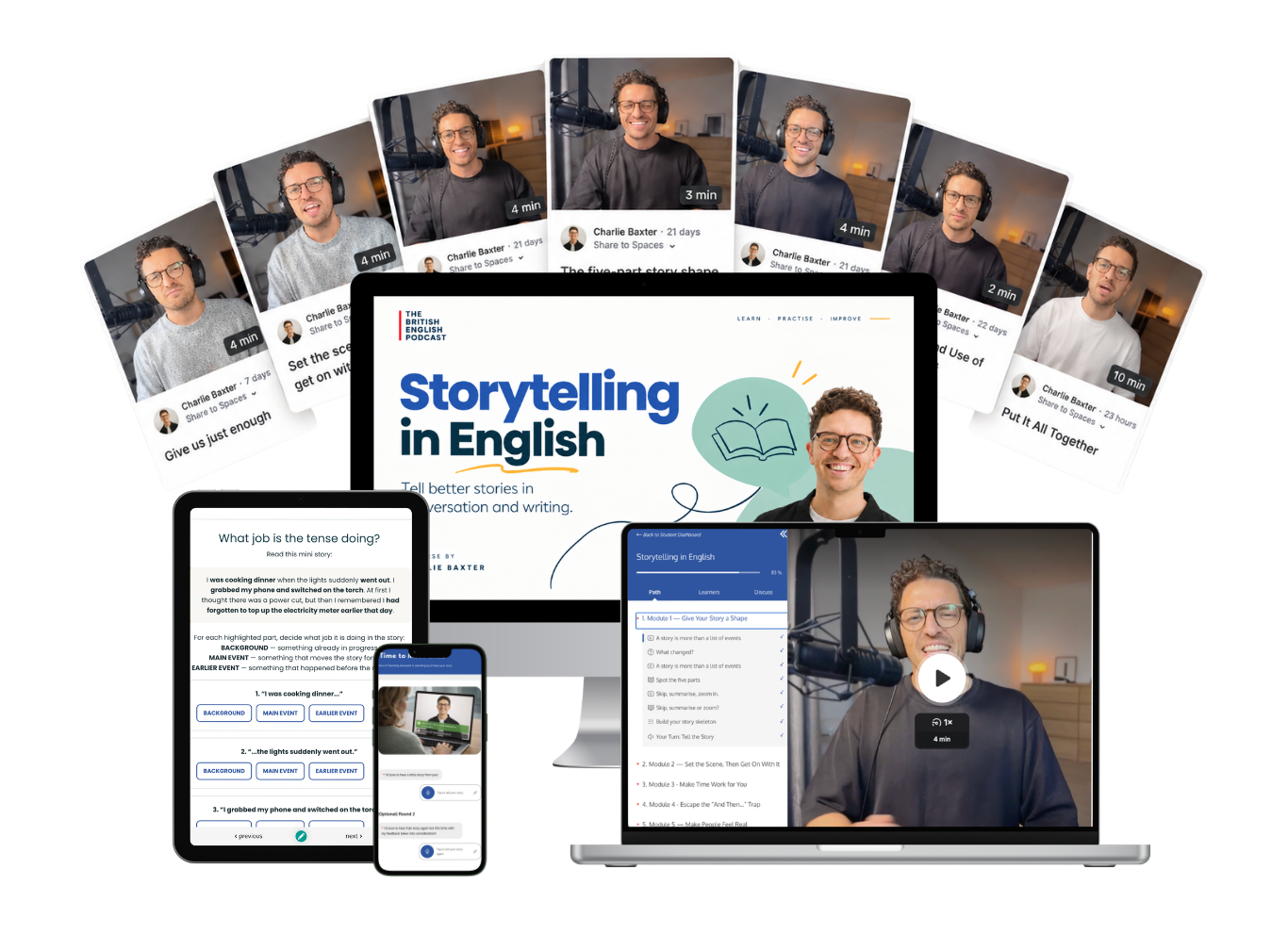
Practical teaching with Charlie
Over 150 minutes of focused lessons and real-life demonstrations to help you understand what makes stories work.
Learn by making decisions
Test your understanding, choose what a story needs and see how different approaches change its effect.
Put your own stories on the page
Practise shaping, revising and improving stories, rather than simply memorising advice.
Get personalised guidance from Chaz
Try your storytelling techniques and get targeted feedback from the AI coach I've personally instructed to follow my teaching approach.
These are my estimated values for the individual parts if offered separately, not previous selling prices.
One complete course. No extra upgrades to unlock the lessons.
Storytelling in English
One-time payment · Lifetime access
Get lifetime access for £99 ↗✓ 60-day money-back guarantee · One payment
Give it a proper go. You've got 60 days.
I don't want you buying this course and then wondering whether it was worth the money.
I want you to try it.
Watch the lessons.
Do the exercises.
Experiment with telling stories differently.
And notice whether you start approaching your own anecdotes with more confidence and understanding.
If you give it a proper go and feel it hasn't helped you, you can request your money back within 60 days of purchase.
That's my 60-day money-back guarantee.
I believe you should feel good about the money you spend on your English.
And I'd much rather you joined feeling excited to learn than worried about taking a chance on the course.
Learn to tell stories people love listening to →✓ 60-day money-back guarantee
A few things you might be wondering...
Here are a few answers before you get started.
Is this course suitable for my English level?
If you can already have conversations in English and follow English-language teaching videos, it's designed to be accessible to you. You don't need near-native fluency.
Learners with stronger English can also benefit because many of the techniques are about communication and storytelling decisions rather than basic language knowledge.
Is this mainly for speaking or writing?
The main focus is telling better anecdotes in conversation, but many of the same storytelling techniques also apply to writing. You'll have opportunities to work on both.
Is this a grammar course?
No. We do look at how tenses can help you tell stories more naturally, but the main focus is on making stories clear, interesting and engaging.
Will this help me with everyday conversations too?
It can. While the course specifically teaches storytelling, skills such as choosing relevant details, organising your thoughts and keeping a listener engaged can also be useful when sharing experiences and explaining things in everyday conversations.
Do I need to have lots of interesting experiences?
Not at all. We'll work with everyday situations, and you'll also have opportunities to invent stories.
Do I get personal feedback from Charlie?
Your teaching videos are all from me, Charlie. The personalised storytelling feedback comes from Chaz, an AI storytelling coach who I've personally instructed on how to respond to your stories and guide you through the learning process.
So while the feedback isn't coming directly from me, Chaz has been carefully set up to follow my teaching approach and focus on the storytelling skills we explore throughout the course.
What if I don't have much time?
It's a self-paced course. You can work through the lessons when it suits you and come back to them as often as you need.
How long can I access the course?
You'll have lifetime access, so there's no rush to finish everything within a particular number of days.
What if I buy it and decide it isn't right for me?
Your purchase is covered by a 60-day money-back guarantee, so you can try the course and request a refund within that period if it hasn't helped you.
Imagine being the person everyone wants to listen to.
Remember those people we talked about at the beginning?
The ones who can start telling a story about something completely ordinary and somehow have everyone hanging on their every word?
Well, imagine the next time you're chatting with friends or colleagues...
You're the one telling the story.
People are interested.
They're laughing at the funny bits.
They're asking questions.
And rather than worrying about whether you're boring everyone, you're actually enjoying yourself.
But here's something else worth thinking about.
What happens when you become someone who's more willing to speak up?
People start getting to know you better.
Not just as the person who speaks English as a second language, but as the individual you really are.
Your personality. Your sense of humour. Your experiences. Your opinions.
And the more you contribute to conversations, the more opportunities you give yourself to practise your English.
The more you practise, the more comfortable you can become.
And the more comfortable you become, the more likely you are to join in next time.
It's a lovely little snowball effect.
All because you're becoming more willing and able to share what's on your mind.
Of course, not every story will have everyone on the edge of their seats.
But imagine feeling more confident that when you've got something worth sharing, you know how to make people want to listen.
And instead of watching other people take centre stage in conversations, you're enjoying being part of them yourself.
You've already got the experiences, the personality and the stories. I'd love to help you share them.

See you inside!
Charlie
Storytelling in English
One-time payment · Lifetime access
✓ 60-day money-back guarantee
Lifetime access · 10 modules · Interactive practice · AI feedback
Same experience.
Pretty much the same vocabulary.
But notice what changed.
We get to the interesting bit faster.
We experience the mistake as it's happening.
We hear the other person's reaction.
And the story stops without summarising the embarrassment.
That's what I want to help you do.
Not memorise hundreds of fancy phrases.
Not turn every little anecdote into a dramatic performance.
Just learn how to tell your stories in a way that makes people want to listen.